William "New Age" Blake (1757-1827)
William Blake was born 28 November 1757, third and strangest son of James Blake and his wife Catherine1. His life started off weird and never improved. At the tender age of four, he had his first vision2. Though his parents may have thought it was all right at first, his father was very upset William was still having them at eight. James decided, probably quite rightly, not to put William in school. He learned to read and write at home, and also showed a great aptitude for drawing. He was sent to a drawing school at age ten, and his father arranged for William to be apprenticed to an engraver as soon as he was old enough3.
William bought every print he could possibly afford. He drew sketches of monuments throughout the London area. Oh, yes, and he also wrote some poetry. His first collection (published 1783) was the Poetical Sketches, lyric poems written between the ages of twelve and twenty. Though mostly derivative of other poets' work, these early poems show the beginnings of the Romantic ideas of emotion over form4, and they're still read today, which is more than you'd expect of such early stuff. In William's case, it's the later poems that don't get read anymore. But I'm getting ahead of myself. William's work was unusual for the time: he never attempted a sonnet, as near as we can tell, and he really wasn't very good at couplets, which all of his contemporaries considered the only good forms of poetry.
William attended the Royal Academy after finishing his apprenticeship and was soon able to support himself by his engraving. On 18 August 1782, he married a woman named Catherine Boucher5. She accepted the visions that William was still having with no apparent qualms. They never had any children, nor did any of William's siblings. For some reason, this fact is sometimes listed as proof that there was a lot of insanity in William's family6. William's behavior was awfully strange, and he never made the slightest attempt to hide it. After tending to his brother Robert on his deathbed, William said quite casually on several occasions that he still saw and conversed with Robert on a regular basis. William's later poetry collections were printed using an engraving process which Robert had described during one of these post-mortem conversations.
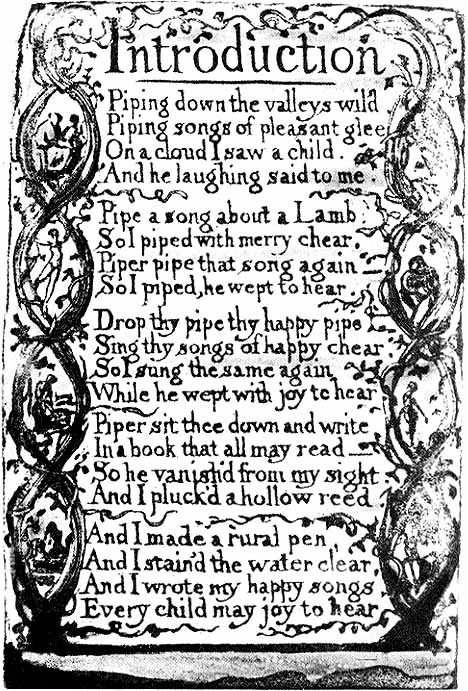
In 1789, Songs of Experience was published. In 1789, Songs of Innocence and of Experience Shewing the Two Contrary States of the Human Soul was published7. William also designed illustrations for these poems and they look pretty cool. The Marriage of Heaven and Hell, written about this time, was William's first really offbeat work, and this and everything he wrote after it aren't really read a great deal anymore. One thing that might have inspired this change in William's work was his study of the philosopher Emanuel Swedenborg, who stated his belief that the year 1757 (the year of William's birth) would mark a grand "New Age" which would allow mankind to regain moral freedom8.
Amongst writing his poetry, William earned extra money by teaching drawing to the sons of friends of his. One of these friends, Thomas Butts, Sr., kept William from poverty for many years, through teaching fees and out and out gifts. Rather than earning money, William was usually to be found channelling the spirit of John Milton9, a favorite author of his, or possibly drawing sketches of the heads of the famous dead people who would come and sit for him10.
In spite of the fact that he was very much NOT famous, he won the patronage of Lady Caroline Lamb, and was then in a much better financial position. His engravings were much prized by publishers and other authors, however, and William much appreciated the admiration he received from younger artists towards the end of his life. His poetry, however, was not destined to be appreciated much until after authors such as Coleridge became popular.
After several years of failing health (he suffered shivering fits and jaundice from 1824 on, symptoms of the gallstones which would later kill him), William died on 12 August 1827, singing to his wife of what he saw of heaven11. His wife outlived him by four years, gradually selling off those of his manuscripts and engravings that she still had for money to live on, and claimed that William would visit her each day, sitting and talking with her for two or three hours. She often refused to reach a decision until she was able to consult with him12.
- Catherine's maiden name was probably Harmitage, though no one's quite sure. No, she isn't very important.
- He wrote later that God 'put his head to the window and set him a-screaming.' Yikes.
- William had a bad feeling about the first engraver his father chose, and asked for a different teacher. The first choice was later hanged for forgery.
- Or ecstasy over excellence. William isn't really a Romantic, but he's often labelled as such. I don't think he'd like that, actually.
- Think My Fair Lady. William taught his wife to read, write, draw, and print and color his engravings.
- I don't get the connection either. I look on that fact as proof that anyone who says he or she is descended from William Blake is full of it.
- Some poems actually migrated from 'Experience' to 'Innocence' by the second volume. Maybe he was a bit confused.
- William seems to have taken this sort of thing in general quite seriously. Most of his later works are considered 'prophetic' works.
- NOT made up. He wrote two books of a poem called Milton: A Poem in Twelve Books which he claimed were written by Milton through him.
- Also not made up. Such deceased luminaries as Sir William Wallace, Edward I, and Lot of Biblical fame would sit for him late at night. He also drew a rather frightening little sketch which he said was the soul of a flea.
- Catherine had once, in all seriousness, told a friend, "I have very little of Mr. Blake's company; he is always in Paradise."
- They must have been very well-suited for each other.
Manuscript Image